St Mary’s Matters – Easter Reflection from the Chaplain
Slowing Down to See
Many of us feel the same pressure as this busy term draws to a close: the sense that time is moving too quickly. Deadlines, activities, commitments, and responsibilities fill our days. Before we know it, the term has passed and so has the first quarter of 2026.
In a school community, time can feel compressed. There is always something happening, somewhere to be, something to prepare for next week and the next.
Yet the Christian season of Lent offers us a very different rhythm.
Lent does not rush. It unfolds slowly, step by step, inviting us to pause and pay attention. It is a season that asks us to slow down long enough to look honestly at our lives, our choices, and our hearts. Perhaps we may regret our lack of time or our inability to focus as the weeks of Lent have passed, but God’s grace reminds us that we tried. God is gentle with us, especially when we realise how easily we are swept up in the pace of life. Each day of Lent has formed us, even in the small moments when we turned our minds and hearts toward God. We are invited to gather those moments and let them hold us as we enter Holy Week.
The season of Lent leads us towards the final stages of Jesus’ final days: Palm Sunday, the Last Supper, the cross of Good Friday, and onwards towards the wonder of Easter morning. These are not simply events we remember quickly before moving on. They are moments the Church has long recognised as part of a deeper journey of reflection and transformation.
If we are fortunate enough to press pause when school closes, we might enter the holiest days of the Christian year with a sense that time is stretched out, more deliberate, almost tangible. I urge us to be silent, to sit still and make it so. We are asked to notice and remain present to each moment. Just as a muddy pond becomes clear when the water is stilled and the cloudiness settles, our minds see more clearly in unhurried spaces. From Thursday evening to the silence of Saturday, the Church lingers. There is time to sit with uncertainty, with loss, and with what is unresolved.
Theologian and priest Revd Fleming Rutledge teaches that the crucifixion is not a past event that we look back upon; it is something we are brought into. Not only the story of Christ, but something of our own lives, whether it be seasons of loss, of waiting, or of hope not yet realised. We prefer to avoid our feelings of discomfort as we “smile and wave” through our busy days, moving quickly past difficulty rather than through it. While we prefer the celebration without the waiting, the moments we would rather avoid are not outside of God’s presence. They are often the very places where love is formed.
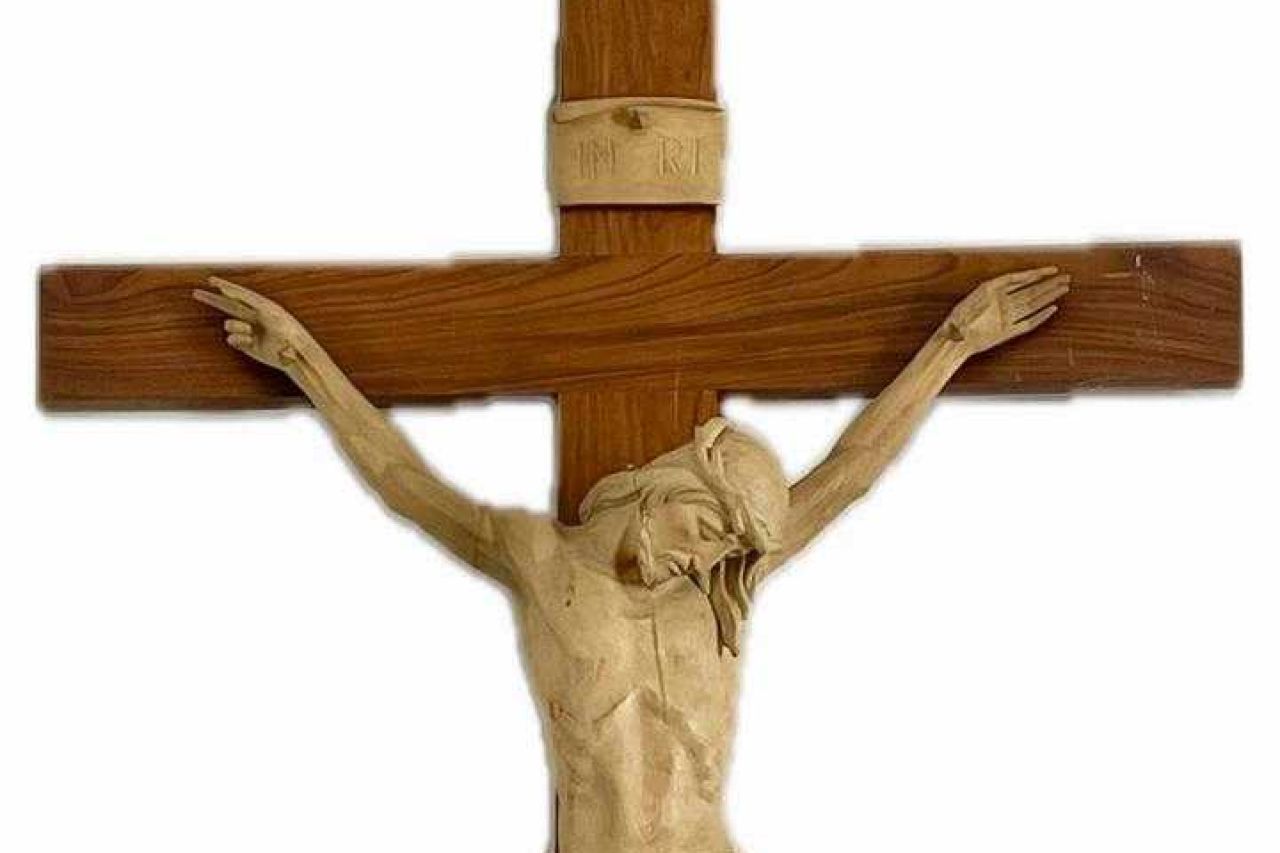
Our students often ask why the crucifix (Jesus on the cross) hangs in our chapel, rather than the empty cross of the risen Christ. It is not that one should be held over the other. The resurrection does not stand apart from the crucifixion. The two belong together.
The crucifix invites us not to look away too quickly. It asks us to pause and see what is revealed in the cross itself. Fleming Rutledge writes, “The cross is not a detour or a hurdle on the way to the kingdom, nor is it even the way to the kingdom; it is the kingdom come.” In the cross, Jesus is revealing the heart of God’s kingdom. Not power over, but presence with. Not success, but love that stands in solidarity with suffering. In the crucifixion, we see the kingdom breaking through, not as victory in the usual sense, but as God’s love that gives itself and does not turn away.
In these days, we are invited to hold those both close and far in prayer: our own lives, and the lives of those living with fear, loss, and uncertainty. We remember places marked by war, by threat, and by the quiet strain of not knowing what comes next.
The cross does not stand apart from this. It meets us and calls us to see differently. In a world marked by conflict, division, and suffering, it shows us that in Jesus, God does not remain distant, but enters human pain and works within it for redemption.
Let us not rush past the crucifixion, hurrying ahead to the celebration of resurrection. Let us move through it with Christ. In staying with the story, Easter begins to feel real: not an escape from reality, but a deeper hope that has faced suffering – life that comes through death.
Even now, in a world where fear and conflict are close at hand, the message of Easter holds: hope is not wishful thinking. It is something we are given, and something we are asked to live out, choosing not to give in to fear, acting with kindness, holding onto what is good, and following the way of Jesus, whose love does not turn away.
God of Easter, you bring life out of death and hope where none seemed possible. In this season of resurrection, open our eyes to the quiet work of renewal and lead us into the life you promise. Amen.